
Drilling into Tenerife’s geothermal future
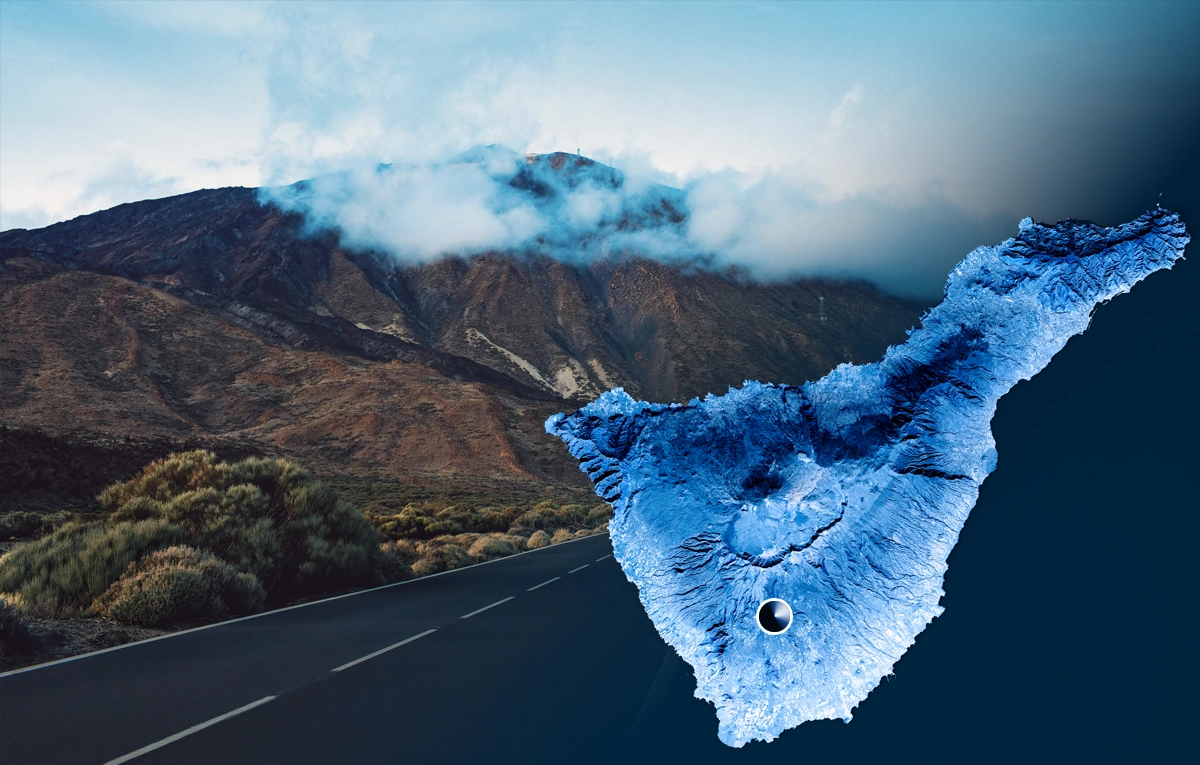
Tenerife is known worldwide for its volcanic landscape. Mount Teide, Spain’s highest peak, rises from the centre of the island as a visible reminder of the geological forces that formed the Canary Islands.
Tenerife’s volcanic geology makes it a natural candidate for geothermal exploration. However, volcanoes alone don’t guarantee a viable geothermal resource. The heat must be close enough to the surface to be reached economically, and the underground rock must allow water or steam to circulate. Until now, the key question has been whether Tenerife’s volcanic subsurface can meet these requirements in practice.
Tenerife’s geothermal potential has long remained largely unexplored. Unlike Iceland, where geothermal energy plays a clear role in heating homes and buildings, the Canary Islands have had less need for space heating. Their energy challenge, however, is very real. Island grids require stable, local, and renewable electricity sources, and the Canaries have historically relied heavily on imported fossil fuels for power generation.
From volcanic promise to exploration
Now, Tenerife is taking a more concrete step towards understanding what lies beneath the island. In early 2026, geothermal exploration drilling began in Vilaflor, on the southern side of the Teide. The aim is to investigate whether the area can support future geothermal energy production.
The project is being developed by Reykjavík Geothermal and DISA, a Canary Islands-based energy company, with EU support for drilling activities. The first drilling work in Vilaflor was carried out by Marriott Drilling Group, a UK-based drilling specialist with a long track record of deep, technically demanding onshore projects.
Marriott’s first phase in Tenerife began in early 2026. The task was to install the so-called upper conductor sections for two future boreholes: one for extraction and one for reinjection.
In geothermal drilling, these conductor sections serve as the large-diameter, steel-cased starting points for the wells. They stabilise the top of the borehole, protect the surrounding ground, and provide a foundation for continued deeper drilling.
The conditions were far from uniform. “We had some challenges,” says Marcin Kurmaniak, Drilling Engineer at Marriott. “We encountered hard but weathered cracked rock, frequent driller’s breaks, formation change to clay, and then from around 45 metres a sudden change to very hard rock.”
Large-diameter Robit tools in action
For the conductor installation, Marriott used Robit’s large-diameter Down the Hole drilling tools, including a Robit® Hyper 241 hammer and a Robit® DTH Prime 762 mm XXXL casing system. The conductor casing was installed to a depth of around 40–60 metres below ground level and cemented to the surface.
Marriott’s confidence in the Robit system was based on earlier experience. “We used Robit hammers and casing systems in 2022 for a deep exploration well project in Albania, drilling large-diameter conductor sections through challenging limestone karst”, says Marcin. “Their performance convinced us of their suitability for demanding conductor installation work.”
In Tenerife, the Robit system performed flawlessly on the first well. On the second, drilling was stopped at 60 metres after a component in the drilling assembly failed. The damaged part was returned to Robit UK for repair.
For Marriott, the geothermal project in Tenerife is continuing, using standard oilfield drilling techniques for the deeper sections. The plans include several wells with target depths of 2,500 and 3,000 meters.
If the explorations prove successful, geothermal energy could eventually provide Tenerife and the wider Canary Islands with a powerful, stable domestic renewable energy source, independent of imported fuel. The first wells in Vilaflor will help show whether Tenerife’s geothermal promise can move from exploration to energy production.