
Drilling into Tenerife’s geothermal future

Tenerife is known worldwide for its volcanic landscape. Mount Teide, Spain’s highest peak, rises from the centre of the island as a visible reminder of the geological forces that formed the Canary Islands.

Tenerife’s volcanic geology makes it a natural candidate for geothermal exploration. However, volcanoes alone don’t guarantee a viable geothermal resource. The heat must be close enough to the surface to be reached economically, and the underground rock must allow water or steam to circulate. Until now, the key question has been whether Tenerife’s volcanic subsurface can meet these requirements in practice.

Tenerife’s geothermal potential has long remained largely unexplored. Unlike Iceland, where geothermal energy plays a clear role in heating homes and buildings, the Canary Islands have had less need for space heating. Their energy challenge, however, is very real. Island grids require stable, local, and renewable electricity sources, and the Canaries have historically relied heavily on imported fossil fuels for power generation.

From volcanic promise to exploration

Now, Tenerife is taking a more concrete step towards understanding what lies beneath the island. In early 2026, geothermal exploration drilling began in Vilaflor, on the southern side of the Teide. The aim is to investigate whether the area can support future geothermal energy production.

The project is being developed by Reykjavík Geothermal and DISA, a Canary Islands-based energy company, with EU support for drilling activities. The first drilling work in Vilaflor was carried out by Marriott Drilling Group, a UK-based drilling specialist with a long track record of deep, technically demanding onshore projects.

Marriott’s first phase in Tenerife began in early 2026. The task was to install the so-called upper conductor sections for two future boreholes: one for extraction and one for reinjection.

In geothermal drilling, these conductor sections serve as the large-diameter, steel-cased starting points for the wells. They stabilise the top of the borehole, protect the surrounding ground, and provide a foundation for continued deeper drilling.

The conditions were far from uniform. “We had some challenges,” says Marcin Kurmaniak, Drilling Engineer at Marriott. “We encountered hard but weathered cracked rock, frequent driller’s breaks, formation change to clay, and then from around 45 metres a sudden change to very hard rock.”

Large-diameter Robit tools in action

For the conductor installation, Marriott used Robit’s large-diameter Down the Hole drilling tools, including a Robit® Hyper 241 hammer and a Robit® DTH Prime 762 mm XXXL casing system. The conductor casing was installed to a depth of around 40–60 metres below ground level and cemented to the surface.

Marriott’s confidence in the Robit system was based on earlier experience. “We used Robit hammers and casing systems in 2022 for a deep exploration well project in Albania, drilling large-diameter conductor sections through challenging limestone karst”, says Marcin. “Their performance convinced us of their suitability for demanding conductor installation work.”

In Tenerife, the Robit system performed flawlessly on the first well. On the second, drilling was stopped at 60 metres after a component in the drilling assembly failed. The damaged part was returned to Robit UK for repair.

For Marriott, the geothermal project in Tenerife is continuing, using standard oilfield drilling techniques for the deeper sections. The plans include several wells with target depths of 2,500 and 3,000 meters.

If the explorations prove successful, geothermal energy could eventually provide Tenerife and the wider Canary Islands with a powerful, stable domestic renewable energy source, independent of imported fuel. The first wells in Vilaflor will help show whether Tenerife’s geothermal promise can move from exploration to energy production.

FNQ Drilling boosts efficiency with the H Series hammer

Far North Queensland (FNQ) is one of the fastest-growing regions in Australia. Despite being the region with the most annual rainfall in the country, FNQ is facing water supply challenges. Particularly along the coast, the area’s capacity to store water for urban use is limited, which may hinder future growth. Some parts of FNQ have even seen water outages in recent years. As a result, water well drilling has proven to be a vital service for households, industries, and farms in many parts of FNQ.

One of the leading companies providing water well drilling services, as well as bore drilling and utility drilling, in the region is FNQ Drilling, a family-owned business headquartered in Bamboo. Their water well drilling service includes site evaluation, well construction, and pump installation.

In a competitive industry such as well drilling, companies must find ways to improve efficiency or reduce costs to maintain a competitive edge. Shane Naude, the owner of FNQ Drilling, switched to Robit drilling tools a few years ago.

“I was using a hammer that kept breaking barrels and shanking bits without resolution. So I asked around other water well drillers and was told to try Robit. I started using Robit in early 2023 with a D45 DHD340 hammer, a D65W HD QL60 hammer, and bits to suit,” Shane reminisces.

In September 2024, Shane got an opportunity to test and validate the performance and reliability of Robit’s new 6″ H Series hammer in water well drilling. The H Series hammer line was more widely introduced to the Australian market at the DRILL24 trade fair in Perth the following month.

A key selling point of the H Series is its modular design, allowing it to adapt to varying practical needs in the field.

“I do water well drilling in and around all FNQ for domestic, rural, and commercial clients. Ground conditions vary greatly, including shale, basalt, granite, marble, clay, and schist. So, a lot of variation in the hammer performance is needed to suit the ground,” Shane explains.

Shane’s business depends heavily on the quality of his tools. “A reliable hammer is key to my success. More drilling and less downtime due to the product not performing to specifications cost my business money and clients. Due to the remote locations I have clients at, such as stations, I require reliable and suitable products to complete my work.”

“Before switching to Robit, I had many issues with failures, e.g., a simple hammer spring continually failing and causing downtime, costing my Company money and time, and a potential loss of reputation to my business,” Shane says.

After months of validation trials, Shane’s experiences with the new Robit H Series hammer are overwhelmingly positive.

“The trial hammer has drilled approximately 500m of water bore drilling only. All components, including the hammer barrel, piston, top sub, and threads, wear better than those of competitor products previously used.”

“I’m achieving more drilled metres per day. The penetration of the hammer is powerful and punchy, which decreases the time needed to drill a hole. I have also noticed a reduction in my fuel consumption,” Shane says.

In product development, Robit has consistently relied heavily on direct customer experiences and collaboration. The H Series hammer is no exception. Throughout the trials, Shane has discussed with Robit and provided valuable feedback to further improve the hammer’s performance, always with an eye toward that competitive edge.

OULUN PORAKAIVOT THRIVES USING ROBIT’S WEAR PARTS

Kauno Määttä was a familiar name to Finnish wrestling fans in the 1960s and 70s: he won the Finnish Greco-Roman wrestling championship in his weight class several times. In his day job, however, Kauno did not make the headlines despite being a respected professional: he drilled wells.

Kauno’s career as a driller continued into retirement and was passed on to the next generations. In the late 1980s, Kauno’s primary school-age grandsons, Sami and Simo Manninen, got the spark when they got invited as helpers for a well-drilling job.

The spark ignited a lasting passion, and as a result, the brothers’ own company, Oulun Porakaivot, was finally born in 2012. It operates throughout Finland, and its core business is drilling geothermal energy fields for large properties. Oulun Porakaivot also handles the design and permitting of the energy fields and has a wide range of customers from the public sector to commercial properties and housing cooperatives. They also drill individual geothermal and water wells for detached houses and other small properties.

Oulun Porakaivot operates six drilling rigs and has long been Robit’s contract customer, using Robit products for all key consumables such as rods, ring bits, drill bits, and pilots. Panu Haulos, Design Engineer at Oulun Porakaivot, has noticed a welcome improvement in the quality of drilling tools.

“Reliability of consumables is critical in this sector. The wells are getting deeper – up to 450 meters – and the plots of land are often small: if the first hole falls short, there may not be enough room to drill a new one. In consumables, we have to look at the cost of a drill meter from an overall economic perspective: performance, drilling speed and fuel consumption. Robit’s products have been consistently reliable and have performed excellently in deep wells. And today’s hammers and bits are more durable than before,” says Panu.

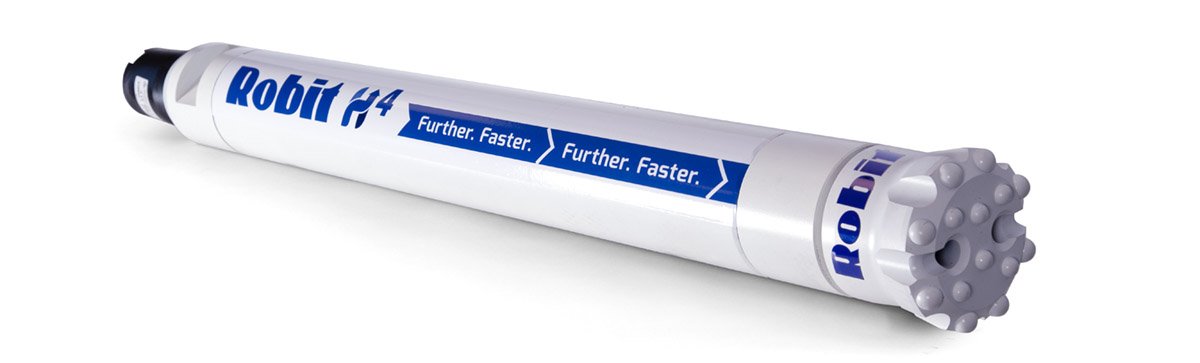
For about a year, Robit has been developing a new four-inch DTH hammer, branded Robit H4, for well drilling. Testing in cooperation with customers is an integral part of product development. The H4 hammer was optimized and finalized as per customer feedback. Robit’s Sales Director Kimmo Kangas approached Oulun Porakaivot and offered them an opportunity to test the new hammer. A suitable test site was found in Helsinki, at a housing cooperative’s future energy field, where 23 wells will be drilled to a depth of 390 metres. Kimmo has followed the development of the H4 hammer from the beginning and has seen its potential.

“The functionality, reliability and penetration rate of the H4 are outstanding. However, the most significant improvement is fuel consumption, which is significantly lower than the competition. Typically, for example, in a 200-meter well, the compressor consumes about two litres of fuel per meter. On the H4 hammer, the consumption has been as low as one and a half litres. That’s a crucial difference,” says Kimmo.

Low fuel consumption is one of the key assets of the H4 hammer.

Panu Haulos confirms that the H4 has achieved very low fuel consumption figures at the drilling test site. The two companies have been in close cooperation for years.

“Robit’s domestic production is definitely a plus for us: we can get parts with a fast response time. They react quickly to our needs, around the clock if necessary. Robit has also been able to help in special cases where off-the-shelf products have not been available. For example, we had a project where the hole we were to drill had to be absolutely straight. Robit tailor-made us a special guiding rod that did the job,” says Panu.

In many sectors of the economy, growth indicators have recently taken a downward turn. This is not the case in the thermal well market, at least not for Oulun Porakaivot.

“The trend is upward, and demand is constantly growing and diversifying. Of course, this is partly due to technological advances that allow us to drill deeper wells. In Finland, the city of Helsinki, in particular, is a strong driver of progress in this field. The city, striving to move away from fossil-based district heating, has streamlined the permitting process for geothermal heat”, Panu says.

Picture from left: Ville Alanko, Simo Manninen, CEO Sami Manninen, Panu Haulos (Oulun Porakaivot); on the right Kimmo Kangas (Robit).

ROTOTEC ACCELERATES THE GREEN TRANSITION

Carbon neutrality is a globally accepted goal to minimise the negative effects of climate change, in which energy production plays a key role. The current military crisis in Europe is a reminder that nations should also strive for maximal energy self-sufficiency. Geothermal energy provides one promising, cost-effective path toward achieving both goals.

In Finland, the growth of geo-energy has been rapid in recent years. One of the key actors in the sector is Rototec, Europe’s largest geo-energy company with more than 60,000 energy wells drilled. Founded in 2007, Rototec has grown strongly in Finland and operates also in Sweden and Norway.

While geothermal energy has long been a popular energy source for single-family houses, Rototec is focusing more on supplying geo-energy for large properties such as hospitals, shopping centres, and factories.

A geothermal system requires one or more bore wells, drilled to a depth of 150–250 metres, depending on the amount of energy required. Robit has been supplying Rototec with drilling tools since the early years of the company.

“Robit, as a big domestic manufacturer, was a natural choice for us. 99% of the holes we drill are four-inch wells and Robit has a comprehensive line of tools for that. Currently, all our drill bits are from Robit,” says Hannu Puolitaival, Technical Director at Rototec.

The fruitful, mutually beneficial cooperation spans back more than a decade and focuses on customer-oriented service.

“Over the years, we have worked closely together to develop drill bits to better meet our needs. We test the products, and share our experience and comments with Robit for further development. One of Robit’s assets is their agility: after our feedback, they can produce new, improved prototypes at a fast pace for testing. Of course, the fact that they have domestic manufacturing helps too,” Hannu says.

“Another strength is that Robit can make small batches. If we’d need, say, five units of a particular new drill bit for testing, that poses no problem. Not all manufacturers can do this,” says Hannu, and adds one more thing: “I have especially liked the fact that Robit has a dedicated person managing all communication with us. It makes our cooperation seamless and straightforward.”


Read more new stories in the latest Bulletin!

Robit® DTH NOVA for demanding, controlled water and energy well drilling projects

Robit has launched the new Superior Casing Systems series for energy & water well drilling – Robit® DTH Nova Series.

Innovative features:

  • Controlled flushing properties
    – Robit® Flow Control – No unwanted flushing into the surrounding soil
    – Robit® Direct Flush – Keeps impact area clean to avoid wear
    – Operates in all ground conditions
  • Optimized face design
    – Faster penetration rate
  • Robust structure
    – Durable, heavy-duty design guarantees longevity

Usage:

  • Ideal for overburden that is thick and full of boulders
  • Available for all the common Down the Hole hammers
  • Available with Robit® Flow Control or Direct Flush technology
  • Designed for all applications where the casing is left in the ground
  • Highly suitable for the drilling of both water well and thermal wells
  • Enables easy, fast, and reliable drilling process in all conditions


Robit® Flow Control – No unwanted flushing into the surrounding soil

Watch the video: Robit® DTH Nova

Download the brochure: Robit® DTH Nova 2-2022

Stay safe with the pioneer of controlled flushing systems!