
FNQ Drilling boosts efficiency with the H Series hammer

Far North Queensland (FNQ) is one of the fastest-growing regions in Australia. Despite being the region with the most annual rainfall in the country, FNQ is facing water supply challenges. Particularly along the coast, the area’s capacity to store water for urban use is limited, which may hinder future growth. Some parts of FNQ have even seen water outages in recent years. As a result, water well drilling has proven to be a vital service for households, industries, and farms in many parts of FNQ.

One of the leading companies providing water well drilling services, as well as bore drilling and utility drilling, in the region is FNQ Drilling, a family-owned business headquartered in Bamboo. Their water well drilling service includes site evaluation, well construction, and pump installation.

In a competitive industry such as well drilling, companies must find ways to improve efficiency or reduce costs to maintain a competitive edge. Shane Naude, the owner of FNQ Drilling, switched to Robit drilling tools a few years ago.

“I was using a hammer that kept breaking barrels and shanking bits without resolution. So I asked around other water well drillers and was told to try Robit. I started using Robit in early 2023 with a D45 DHD340 hammer, a D65W HD QL60 hammer, and bits to suit,” Shane reminisces.

In September 2024, Shane got an opportunity to test and validate the performance and reliability of Robit’s new 6″ H Series hammer in water well drilling. The H Series hammer line was more widely introduced to the Australian market at the DRILL24 trade fair in Perth the following month.

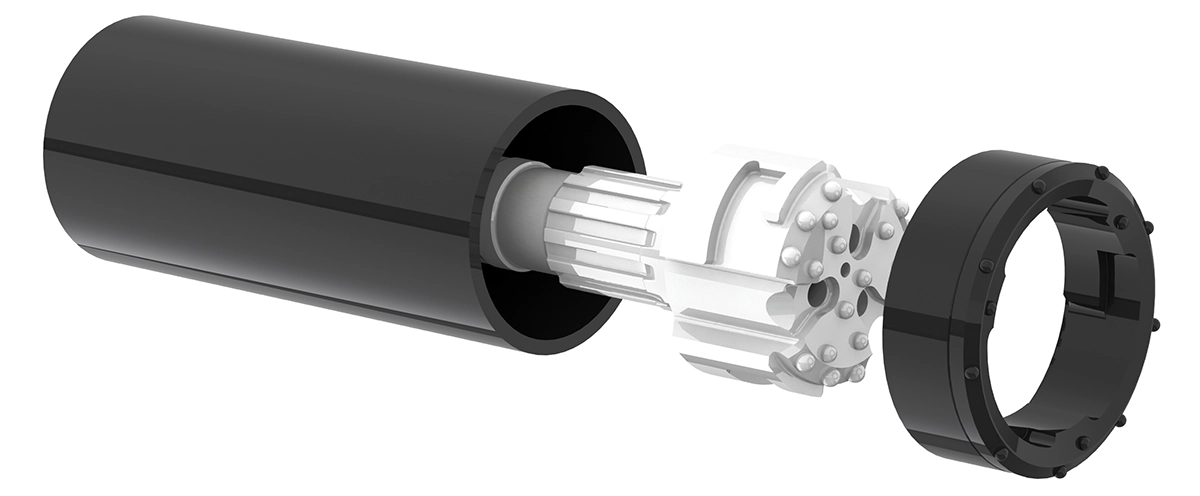
A key selling point of the H Series is its modular design, allowing it to adapt to varying practical needs in the field.

“I do water well drilling in and around all FNQ for domestic, rural, and commercial clients. Ground conditions vary greatly, including shale, basalt, granite, marble, clay, and schist. So, a lot of variation in the hammer performance is needed to suit the ground,” Shane explains.

Shane’s business depends heavily on the quality of his tools. “A reliable hammer is key to my success. More drilling and less downtime due to the product not performing to specifications cost my business money and clients. Due to the remote locations I have clients at, such as stations, I require reliable and suitable products to complete my work.”

“Before switching to Robit, I had many issues with failures, e.g., a simple hammer spring continually failing and causing downtime, costing my Company money and time, and a potential loss of reputation to my business,” Shane says.

After months of validation trials, Shane’s experiences with the new Robit H Series hammer are overwhelmingly positive.

“The trial hammer has drilled approximately 500m of water bore drilling only. All components, including the hammer barrel, piston, top sub, and threads, wear better than those of competitor products previously used.”

“I’m achieving more drilled metres per day. The penetration of the hammer is powerful and punchy, which decreases the time needed to drill a hole. I have also noticed a reduction in my fuel consumption,” Shane says.

In product development, Robit has consistently relied heavily on direct customer experiences and collaboration. The H Series hammer is no exception. Throughout the trials, Shane has discussed with Robit and provided valuable feedback to further improve the hammer’s performance, always with an eye toward that competitive edge.

Mikko Kuusilehto leads Robit into its fifth decade

Mikko Kuusilehto will take up the role of CEO at Robit in August 2025. With an impressive track record of leading industrial companies throughout the 21st century, he brings a wealth of experience to the position. How does Robit’s new leader view the future?

You’ve held leadership roles in several industrial companies. What brought you to Robit?
I’ve had the opportunity to work with companies that’ve been in business for decades, some for over a century. They’ve all been strong industrial players, and the common thread has been a robust culture and outstanding individuals who have made success possible in both good times and challenging ones.

Robit appealed to me because it’s a technically capable, international company with a clear role as a supplier to critical sectors. There’s also a healthy ambition here, a desire to grow and improve profitability. That’s a combination where I feel I can genuinely contribute.

At the heart of Robit is durable, high-performance technology and a focus on serving demanding industries. I’ve worked with similar challenges before. It felt like an opportunity to help shape the next chapter of growth for a company that has both a proven track record and a strong appetite for continued evolution.

What’s your impression of Robit’s company culture so far?
I’ve already had the chance to meet a large number of people across the organisation. My first impression has been overwhelmingly positive. There’s a strong sense of drive here, a wealth of expertise and a desire to solve problems for customers. You can see that in the committed approach people take to their work.

The international nature of the company adds richness, but it also underscores the importance of a shared culture and working methods. I believe great culture doesn’t happen by accident – it’s something we build together, deliberately.

Do you have any ideas for further developing that culture?
The key is to create a shared rhythm and clarity about what we’re trying to achieve and how we track progress. Clarity and rhythm free up time, energy and creativity. When people understand the goals and know where we’re headed, they’re empowered to make decisions and learn quickly. Data and teamwork play a big role.

Another focus area is communication, both internally and with customers. A strong culture includes the freedom to ask questions, share ideas, challenge the status quo and succeed together.

How would you describe your leadership philosophy?
I see leadership first and foremost as a responsibility to enable others to succeed. I aim to be present, listen actively and offer clear direction.

People need to know what we’re working toward and why we’re doing it. I value direct communication, trust and collaboration across teams. Ultimately, we’re measured by our results, so leadership also means being prepared to make decisions and take responsibility.

I want people to feel they have a clear direction, the ability to make an impact, and a sense that their contribution matters. Leadership is about striking a balance between listening and the courage to make decisions – both are necessary to move forward.

There’s a lot of turbulence in global politics and trade now. Does that affect a company like Robit and the way it’s managed?
Absolutely. We need to operate globally while understanding local conditions. Tariffs, logistics, exchange rates and geopolitical risks are part of daily life, and they can have a big impact.

From a leadership perspective, this means having options, being prepared to react, and being able to assess risks quickly. At the same time, you need long-term consistency – strategy can’t swing with every headline. That’s why we need to maintain a stable strategy while remaining flexible in execution.

How do you view Robit’s position and image in the global market?
Robit has a strong technical reputation, and customers value its expertise, flexibility and ability to deliver quality. The brand has a no-nonsense character that suits the environments where our products are used.

Robit is a respected name in the market. Still, I believe we have the potential to become an even stronger international presence, especially if we can consistently deliver a great customer experience and provide clear value to end-users.

Customers must see Robit as a daily partner, not just a supplier of products. That’s how you build differentiation and loyalty that lasts through the toughest market cycles.

Robit already has a strategy in place for the near future. Do you have personal goals you’d like to pursue within that framework?
The current strategy has many strengths, and it’s easy to commit to. What matters now is putting it into action.

I hope we can build Robit into a company that combines strong technical know-how with a sharp commercial edge and a culture where people can grow and succeed together. If we succeed in that, I believe customer and shareholder value will follow.

Everyone needs to have a place in the story and understand how their work contributes to the bigger picture. We also aim to improve the customer experience and explore new ways to grow, both in existing and new markets.

I believe the future doesn’t just happen to us – we shape it ourselves. Our direction is defined by the choices we make, the actions we take and how we work together.

Rebuilding Rönnskär

Foundation work under harsh conditions

In the early hours of June 13, 2023, the small coastal town of Skelleftehamn in northern Sweden was shaken awake by sirens and smoke. A fire had broken out at Boliden’s Rönnskär smelter – Sweden’s only facility for producing base metals and recycling electronic scrap. The electrolysis plant, at the heart of the operation, was devastated. Production halted. Hundreds of jobs were at stake.

Boliden acted quickly. Within months, the company announced a SEK 4.8 billion investment to rebuild the electrolysis facility on the same site, with the goal of making it operational again by 2026. NCC, one of the leading construction companies in the Nordics, was selected as the main contractor, and Hercules, a specialist in foundation engineering and part of the NCC Group, was assigned to handle one of the most critical and complex aspects of the rebuild: the ground foundation work.

That challenge was far from straightforward. The ground beneath the plant was filled with construction debris dating back to the mid-20th century, and it was heavily contaminated with lead, cadmium, arsenic, and copper slag.

This required special protective measures for the structures and the individuals performing the work. The steel piles had to be corrosion-protected using six-metre-long casing pipes, ensuring durability in the toxic soil. Meanwhile, site crews operated under strict safety protocols, requiring a higher-than-normal level of personal protective equipment throughout the piling phase. Add to that a massive scale: nearly 3,000 piles were drilled, totaling 90,000 meters, under a highly compressed timeline.

For this demanding job, Hercules relied on Robit, their long-time partner.

First, Robit’s DTH Prime ring bits were used to drill 323 mm protective casings to prevent the pipe piles from corrosion in the contaminated soil. 168 mm piles were then drilled through the protective casings. Robit’s pilot bits, also from the DTH Prime range, played a central role in the process.

“Hercules Site Managers Robert Kangasmaa and Jonas Hedlund have reported that the tools performed extremely well in the challenging conditions. Hercules, our long-standing customer, was very satisfied with their performance,” says Ville Pohja, VP Geotechnical at Robit.

While Robit and Hercules have collaborated on numerous projects over the years, this was by far their largest effort to date.

“In piling, a large project typically involves a few hundred piles – this one had almost 3,000. We were proud to be able to supply such a large number of ring bits on short notice and at a rapid pace,” Pohja adds.

The piling phase, which ran from May to December 2024, was executed with precision and speed. Double-shift drilling operations ran for up to 19 hours daily, with more than 70 people involved at the project’s peak.

With the foundation work now completed, the new electrolysis plant is rising – a symbol of resilience and renewal. Once operational in 2026, it will not only restore vital production capacity for Boliden but also bring new employment opportunities and long-term benefits to the Skelleftehamn region.