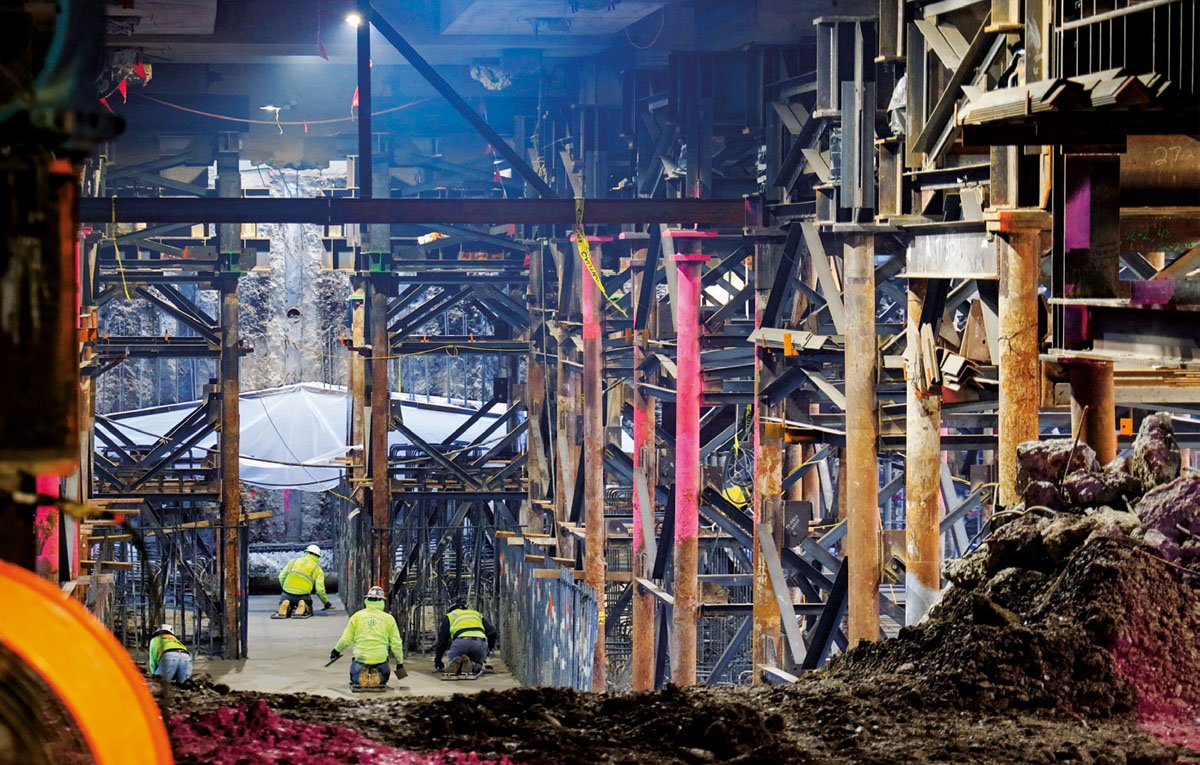
Managed rock tools service at the Endeavor mine

Endeavor is an underground silver-zinc-lead mine in central-western New South Wales, about 40 kilometres north of Cobar in the Cobar Basin, one of Australia’s premier polymetallic mineral provinces. At Endeavor, Robit is responsible for a full Managed Service Contract for drilling consumables – one of Robit’s first underground sites to use this model in Australia.

From consignment stock to managed service

Mining companies typically choose between two basic models for their rock tool supply. In a consignment stock arrangement, the supplier holds inventory on-site and the mine draws what it needs, while planning, tracking, and refurbishment largely remain the mine’s responsibility.

In a Managed Service Contract, the supplier takes an active role in forecasting, supplying, tracking, and refurbishing tools on-site. This is the preferred model at bigger operations.

“Most large customers prefer a service contract to consignment stocks, especially when there are five or more rigs on-site,” says Robit’s Peter Healey, Technical Development. “It allows accurate supply to each rig and lets the customer track the performance of the rig and crew. It also enables refurbishment of the drill string components on-site where possible.”

For Robit, this is a relatively new way of working in Australia. Endeavor is one of the early adopters of the model, alongside Gold Fields’ Agnew operation in Western Australia.

Life-cycle responsibility

”At Endeavor, we have assumed full life-cycle responsibility for their rock tools – from forecasting, supply, and on-site logistics to product support, refurbishment, targeted personnel training, and comprehensive performance reporting with data analysis,” Peter explains. “We manage the day-to-day operation of their rock tools and collaborate with them to drive continuous on-site improvements.”

Refurbishment on-site extends bit life where conditions allow, helping to lower drilling costs. “Lower cost-per-meter through managed control of the drill consumables and operator training to get the most out of the product,” is how Peter sums it up.

How it works on-site

On-site, the Robit operative visits all drill rigs on weekdays. Each day begins underground, with drill strings checked, failed components replaced, and blunt bits exchanged for refurbished or new ones. All changes are logged at the rig, which links tools and drilled meters to specific rigs and crews.

The work continues in the surface workshop. The blunt bits are refurbished: a depletion bath exposes the carbides, which are then sharpened on a bit grinding machine. The refurbished bits return to stock, ready for another cycle underground.

Robit’s agreement with Polymetals at Endeavor has been in place since late 2024, with the service component added in March 2025.

Still in its early stages at Robit, the concept of Managed Service Contracts is quickly taking shape and will be offered to any new Australian customer with multi-rig sites.

Veljekset Toivanen extracts precious metals with Robit tools

When drilling through hard Finnish rock, high-quality consumables are essential. Veljekset Toivanen relies on Robit’s expertise and service to keep its drilling equipment performing reliably day after day.

Based in Kemi, Finland, Veljekset Toivanen Oy is a family-owned company established in 1983. Over the decades, it has grown from a local earthmoving business into a versatile expert in infrastructure and mining services. Starting from southwestern Lapland, operations have expanded across Finland and northern Sweden.

“We are a reliable and innovative mining services provider. We support our customers in both underground and open-pit mining. At the moment, we serve as the main contractor at Endomines’ Hosko gold mine in Ilomantsi and at Sotkamo Silver’s silver mine in Sotkamo,” says Mika Hartikainen, Head of Mining Operations at Veljekset Toivanen.

Comprehensive mining operations

Veljekset Toivanen can manage the entire operation of a mine when required – a task that demands a wide range of machinery, transport capacity, and skilled personnel.

“Our services include production drilling, forepoling, face drilling, crushing, loading and hauling of aggregates, underground support operations, as well as renovation, construction, and maintenance of mine infrastructure,” Hartikainen explains.

In rock excavation and forepoling, the company relies on powerful drilling equipment.
“We operate around twenty machines in total – tunnel jumbos, surface drill rigs, underground production drill rigs, as well as cable bolting and rock bolting rigs,” he adds.

Consumables always in stock

When it comes to drilling consumables, Toivanen has trusted Robit for many years.
“Robit supplies all components needed for drilling – bits, shanks, rods, and casings. We work in close collaboration in product development, the products are high quality, and deliveries are always on schedule,” Hartikainen notes.

Robit delivers consumables to consignment warehouses located at the mine sites, ensuring that a two-month supply is always readily available.
“Mining operations cannot afford unplanned downtime, so we make sure to maintain sufficient stock for all critical consumables. We replenish stock once a month and respond quickly to any changes in demand,” says Kimmo Kangas, Sales Director at Robit Finland Oy.

Products tailored to customer needs

Robit designs and manufactures all drill bits for underground drilling at its Lempäälä factory, enabling close cooperation with Finnish customers.
“We can tailor products to specific customer requirements quickly and cost-effectively, even for smaller production batches. We stay active in the field, discuss evolving needs, and develop better solutions together to improve drilling efficiency and reduce costs,” Kangas says.

Drilling solutions for every rock type

Finnish rock is famously hard – and no two sites are exactly alike.
“At the Sotkamo mine, in addition to the rock’s hardness, the layered structure creates challenges. Drilling tends to drift in the slate zones, causing rods to bend and making it difficult to achieve perfectly straight holes for blasting. Together with Robit, we have tackled this by optimising the placement of carbide buttons, redesigning flushing grooves and the bit body, and selecting the optimal rods and casings. As a result, drilling control has improved, and the consumables now reach more drill meters,” Hartikainen explains.

“We have made other improvements, too. For example, in cable-bolting rigs, making small changes to the thread profile of the rods has increased reliability. In addition, we have achieved excellent results with Robit’s Extreme Carbide bits designed for the hardest rock,” he concludes.

Picture: Mika Hartikainen (left), Head of Mining Operations at Toivanen, and Robit’s Sales Director Kimmo Kangas at the Endomines’ Hosko gold mine in Ilomantsi, Finland, where Toivanen serves as the main contractor.

Robit RG drill rods gain ground in Swedish quarries

In 2024, we introduced the RG51 shoulder-driven drill rod – a Top Hammer design where the shoulder, rather than the thread, takes the impact. This results in higher stiffness, straighter holes, and a longer service life than conventional C(T)-series rods.  Today, the RG rod family is well on its way into the Nordic market.

With RG45 now joining RG51 and RG60, Robit can offer a complete range of shoulder-driven rods for bench drilling and quarrying. Sweden, through long-time distributor Eurodrilling, is among the first countries where the RG45 and RG51 systems are being actively used and tested.

Field trials have been carried out at several sites, with two experienced blasting contractors standing out as early adopters: Bohus Bergsprängning and Alingsås Sprängtjänst. Both operate demanding rock-drilling jobs where tool life, hole straightness, and reliability are closely monitored.

At Bohus Bergsprängning’s quarries, RG45 rods (3,660 and 4,265 mm) and RG45 bits (76, 83, and 89 mm) have been running in daily production since spring 2025. In midsummer, Robit’s Sales Manager Santeri Sillanaukee and Drillmaster Harri Piispanen, together with Eurodrilling’s Bosse Bäckgren, followed performance on site. Bohus Bergsprängning has already noticed the difference in performance and moved from trials to regular RG45 usage.

In October 2025, Alingsås Sprängtjänst hosted a demo day at its premises in Alingsås. After a short introduction to Robit and the RG concept, the team mounted RG45 rods and bits on the customer’s rig and drilled test holes in a nearby rock. The results were so convincing that Alingsås Sprängtjänst decided to start using RG45 right away.

The Swedish experiences so far mirror Robit’s earlier field data from Finland, where RG45 rods have regularly achieved service lives of over 50% and, in some cases, more than 70%, longer than those of standard C45 tools. Users also report straighter holes thanks to the stiffer shoulder-driven connections, better penetration when combining RG rods and RG bits, and noticeably easier uncoupling, all of which translates directly into less downtime and more drill metres per shift.

“We see Sweden following the same trend as Finland, where the Robit RG45 and RG51 systems are becoming the new standard in bench drilling and quarrying. These products truly speak for themselves and help our customers drill better. Day in and day out”, says Sales Manager Santeri Sillanaukee.

To support growing demand, Eurodrilling has begun stocking RG rods and RG bits in Sweden and expects volumes to increase further as the RG concept continues to win new users, carving out a stronger position for Robit in the Swedish Top Hammer market.

La Arena: Precision drilling in Peru’s Andean copper–gold belt

High in the mountains of northern Peru lies the La Arena open-pit mine, a combined gold and copper operation. The site sits along one of the world’s largest porphyry copper–gold belts, part of the Andean metallogenic area that has yielded many of South America’s major deposits. As of late 2024, the mine is owned by Zijin Mining.

The geology at La Arena is notably abrasive, with hard volcanic and intrusive formations that place significant stress on drilling equipment. These ground conditions make controlled blasting especially important, and the mine relies on pre-splitting to define stable walls and predictable bench geometries. Pre-splitting involves drilling a precise line of holes ahead of the main blast, creating a clean fracture plane that limits overbreak and improves overall pit stability.

Pree-splitting at La Arena is performed by Spanish company Acciona, a global infrastructure and mining contractor. Acciona uses 4” Down the Hole hammers paired with 5” bits. Because of the highly abrasive rock, tool life has been a long-standing challenge, prompting Acciona to run a series of comparative tests to identify equipment that could best withstand the conditions.

In mid-2025, Acciona invited Robit to participate in the tests. The setup included the Robit® H4 Marathon hammer with a TD40 shank, along with three different sets of drill bits. Robit’s DTH Drillmaster, Renato Castro, supervised the trial on site, ensuring proper operation, monitoring wear, and gathering performance data. The test period ran from June to July 2025.

The results were decisive. The Robit H4 Marathon hammer achieved a total service life of 4,740 drill meters, significantly outlasting the competitor, which reached 3,100 meters.

Bit performance showed the same trend. In the extremely abrasive rock, Robit’s bits averaged at 140 meters, while competitor bits averaged around 65 meters. Among the designs tested, the convex-face bit with Extreme Carbide gauge inserts delivered the best balance of durability and penetration.

Encouraged by the results, Acciona is exploring additional bit designs with Robit, including Extreme Carbide models, to further reduce cost per meter and improve productivity. The Marathon hammer has already convinced the contractor with its longer lifetime and penetration rates about 30% faster than the competing product.

For Robit, the successful trials represent a promising technical outcome – and the foundation for a potential long-term collaboration.

Destia builds the Vantaa light rail using Robit tools

Picture above: At the Tikkurila tram  line construction site, from left:  Project Manager Alexei Kesonen (Destia),  Drill Master Raivo Forsel (Robit) and  Site Manager Kai Jaakkola (Destia)

After decades of planning, the Vantaa light rail project in Finland has entered construction. Preparatory works began in spring 2025 in the Tikkurila railway station area, and by the end of the year, construction sites were launched elsewhere along the route as well. 

Two alliances, one shared goal 

The Vantaa light rail is being built using an alliance model, in which the client, engineering partners, and contractors operate as a single integrated team. In Vantaa, the project is divided into an eastern and a western alliance. On the west side, Destia acts as the construction contractor, with Ramboll and Sitowise responsible for engineering.

The western alliance section runs from the airport to Jokiniemi and includes a tram tunnel passing beneath Tikkurila railway station.

Tikkurila – a demanding transport hub

At Destia, the ground improvement works for the Vantaa light rail project are led by Project Manager Alexei Kesonen.

“One of the most challenging sections of the entire project is the Tikkurila station area, where an under-ground concrete tunnel of about 800 metres is being built. This requires extensive excavations, in which Robit’s drilling tools play a critical role,” Alexei explains. The tunnel will link rail traffic at Tikkurila with the future tram line, with the tram stop located underground.

Towards the end of the year, a pipe pile wall project is underway in Tikkurila. Some 400 piles of a Ø 610 mm drilled pile wall are being drilled 1–2 metres into the bedrock. The piling work is performed with Robit casing systems – Robit® DTH SR pilot and ring bits – together with an 18” Down the Hole hammer.

In addition to pipe pile walls, excavations are supported by sheet pile walls and combi walls. At its deepest point, the pipe pile wall reaches 13 metres.

“All excavation walls will later be anchored with cable anchors, drilled using a DTH hammer and Robit’s through-drilling reamers and pilots. The tunnel excavation will also include 220 mm rock sockets. 323 mm pipe piles support the tunnel base slab. All critical drilling equipment comes from Robit, and it has performed reliably,” Alexei says.

Pipe-pile-wall piling ongoing

On-site support from Robit

Robit Sales Manager Jonne Merikanto adds that,  in addition to supplying tools, Robit supports the tram project by sharpening the customer’s pilot  bits and servicing hammers at its Suutarila facility. Robit’s Drillmaster Raivo Forsel is also available to Destia whenever needed. “Destia has such skilled drillers, though, that they rarely need assistance,” Raivo notes with a smile.

A central location brings its own challenges

The Tikkurila construction site is located close to the railway, in the heart of the city. “This places significant constraints on the work, most notably public transport operations, traffic management, and limited working space,” Alexei explains.

“In demanding sites like this, the alliance model has proven to be an excellent solution. Its greatest strength lies in flexibility and the ability to respond quickly to changing conditions. The model allows the client, engineers, and contractors to jointly develop and adjust plans almost in real time to find the best possible solution for each situation.” 

“At this early stage of excavation, the greatest challenges are likely to be underground. We expect significant volumes of pressurised groundwater and sections of poor-quality rock. The collaborative nature of the alliance model is crucial for managing and resolving these geotechnical challenges efficiently.”

Foundation works at Tikkurila station will continue well into 2026. In spring, the pile walls will be anchored at a 45° angle into the bedrock using Robit’s through-drilling Prime DT systems.

At the same time, construction of the Vantaa light rail will expand in stages to other sections of the route. If everything proceeds as planned, tram operations in Vantaa will begin in late 2029.

From left – Robit's Drillmaster Raivo Forsel with Site Supervisor Ahti Liivak , Site Manager Kai Jaakkola, and Site Supervisor Santeri Niemi from Destia

Kevitsa rock pushes DTH hammers to their limits

In 1987, some 30 kilometres north of Sodankylä in Finnish Lapland, prospectors made a promising discovery: their rock samples contained nickel and copper. It soon became clear that this Kevitsa ore find was one of the largest ever made in Finland. 

In the 1990s and early 2000s, the mining rights for the deposit changed hands several times. Actual mining did not begin until 2012. Since 2016, the Kevitsa open pit has been owned by the Swedish company Boliden. In 2024, it processed almost 10 million tonnes of ore, primarily nickel and copper, as well as cobalt, platinum, palladium, and gold.

Today, Boliden Kevitsa’s polymetallic mine is one of the largest in Finland. It provides direct and indirect employment for hundreds of people in Lapland and generates significant tax revenues for the region. Production is expected to continue well into the 2030s.

Responsible metal production in Arctic conditions The strategy of the Swedish metals company Boliden revolves around responsible mining, circular-economy solutions, and the production of critical metals for the green transition. Boliden Kevitsa’s polymetallic mine is an integral part of this whole.

The bedrock at Kevitsa is demanding in all respects. The rock is both tough and extremely abrasive, says Juha Ranta, Drilling Development Coordinator at Boliden Kevitsa.

“The mixture of various ore zones, wall rock, and waste rock has formed over thousands of years. Alongside the copper and nickel, there is cobalt, platinum, palladium, and gold, and each zone behaves differently when drilled,” Juha explains.

The natural conditions in Sodankylä don’t make mining any easier either. “In winter, the groundwater in the pit is completely frozen. The hammer must operate just as reliably at -40 degrees as it does at +35 degrees in the summer. That’s a tough combination for any equipment,” Juha says.

Technologically, Kevitsa is a state-of-the-art mine. Production drilling is conducted almost entirely by remote control. From the control room, operators monitor the drill rigs working in the pit around the clock.

An unmanned drill rig plus two men – Kimmo Kangas, left and Juha Ranta.

Testing and developing Robit’s H8 DTH hammer together 

Since early 2025, Robit’s H8 DTH hammer has been tested and developed at Kevitsa in close cooperation with Boliden, says Robit Sales Director Kimmo Kangas.

“The feedback from the operators has been encouraging: the H8 is easy to drill with, penetration rate is good, and durability looks promising,” Kimmo says.

The H8 hammer has been tested with two different 229 mm drill bits to optimize the combined performance of hammer and bit for Kevitsa’s conditions.

The H8 is by no means the first hammer to be tested in Kevitsa’s demanding rock. Tools that perform well elsewhere have often revealed weaknesses in Lapland. “Here, for example, rock hardness and the way the impact energy bounces back from the rock can be very different from what you encounter in other mines,” Juha notes.

Cooperation with Robit’s product development team has been close. “Whenever we’ve found a component that doesn’t last, we’ve sat down together to decide what to do about it. Do we change the material or redesign the part completely? Recently, we’ve focused on improving the hammer’s wear life, first the ‘innards’ and now increasingly the durability of the hammer body,” Juha says.

At Kevitsa, the “Marathon” version of the H8 hammer is in use, featuring a wear-protected outer casing. The goal is to extend service life and reduce both downtime and spare part consumption.

A step towards more economical and sustainable mining 

Boliden works systematically towards environmentally friendly and cost-efficient mining. “The drilling tools are one part of that. With the right tooling, you can achieve substantial cost savings, both in the equipment itself and in fuel efficiency,” Juha points out.

“Equipment durability and reliability have a direct impact on cost per drill meter. As wear resistance improves, material flows – and therefore costs – go down.” 

“New surface treatment methods also allow us to make the materials more wear-resistant. Reliability improves when components that have proved weak are reshaped and redesigned.” Testing the H8 hammer at Kevitsa is part of this overall effort. “With measures like these, we keep moving towards economical mining, with green values firmly in mind,” Juha Ranta concludes.

Robit’s H Series hammers: Changing the game through modularity

In addition to increasing performance, the drilling industry faces ever-growing demands regarding energy efficiency and cost control. These are all issues the H Series hammer line seeks to tackle.

A modular breakthrough in hammer design
The H Series represents a novel approach to hammer design. Primarily designed for drill and blast operations and water well drilling, the hammer range is available in four sizes: 4, 5, 6, and 8 inches.

To meet the diverse demands of different drilling environments, the hammer’s modular design enables up to twelve configurations of a single base assembly for each hammer size. A lighter hammer weight combined with heavier pistons results in higher penetration rates while consuming less energy. The inner cylinders come in two displacements designed to either maximize the power output or enhance efficiency with reduced airflow demand. In addition, by swapping out only two parts, the hammers can be changed from a conventional model using bits with foot valves to tubeless versions and vice versa.

Field-proven performance
The H Series hammer line has been in development for several years, with end-user customers conducting validation trial drillings over several months in real-world settings worldwide, including South Africa. The drill and blast company Brauteseth Blasting, operating the Phalaborwa open-pit phosphate mine in the Limpopo province, has been testing the 6″ H Series hammer there. Brauteseth’s Plant Manager, Owen Du Plooy, reports an increase in the penetration rate, resulting in a 5% lower cost per meter. Other benefits he mentions include easy maintenance, good sleeve life, and a reasonable price. New technologies also bring new challenges, but Du Plooy gives credit to the technical support Robit has been able to provide at short notice.

Another Robit customer, the Drilling and Blasting Division of Zizwe Opencast Mining, serves as the drill and blast operator at the Lwala open-pit chrome mine in the Limpopo province, which is owned by Samancor Chrome. Zizwe started testing the 6″ H Series hammer in October 2024. The mixed ground conditions include fractured rock, sandstone, and clay. In line with Brauteseth’s results, Zizwe has also observed better penetration rates and quicker maintenance on the hammer, as confirmed by Operational Manager Derik Van Deventer.

Next step: the H Marathon Series
Robit has recently introduced a new version of the H Series hammer: the H Marathon Series. Engineered for extended wear life and improved durability, the Marathon focuses on reinforcing the hammer’s most wear-prone parts, such as the drive chuck and wear sleeve.

Brauteseth Blasting has also tested the Marathon hammer at the Phalaborwa phosphate mine. The trials confirmed a significantly longer service life for key components, with only one chuck needed across the entire lifespan of the hammer. The even wear distribution helped reduce downtime and replacement costs, adding another proof point to the H Series’ performance claims.

“A simple fact affects all manufacturers of drilling consumables: no two drilling sites are the same. Consequently, they need to provide the market with a vast range of tools to meet varying needs. As far as Down the Hole hammers go, Robit is looking to change this with the modular H Series hammers.”

FNQ Drilling boosts efficiency with the H Series hammer

Far North Queensland (FNQ) is one of the fastest-growing regions in Australia. Despite being the region with the most annual rainfall in the country, FNQ is facing water supply challenges. Particularly along the coast, the area’s capacity to store water for urban use is limited, which may hinder future growth. Some parts of FNQ have even seen water outages in recent years. As a result, water well drilling has proven to be a vital service for households, industries, and farms in many parts of FNQ.

One of the leading companies providing water well drilling services, as well as bore drilling and utility drilling, in the region is FNQ Drilling, a family-owned business headquartered in Bamboo. Their water well drilling service includes site evaluation, well construction, and pump installation.

In a competitive industry such as well drilling, companies must find ways to improve efficiency or reduce costs to maintain a competitive edge. Shane Naude, the owner of FNQ Drilling, switched to Robit drilling tools a few years ago.

“I was using a hammer that kept breaking barrels and shanking bits without resolution. So I asked around other water well drillers and was told to try Robit. I started using Robit in early 2023 with a D45 DHD340 hammer, a D65W HD QL60 hammer, and bits to suit,” Shane reminisces.

In September 2024, Shane got an opportunity to test and validate the performance and reliability of Robit’s new 6″ H Series hammer in water well drilling. The H Series hammer line was more widely introduced to the Australian market at the DRILL24 trade fair in Perth the following month.

A key selling point of the H Series is its modular design, allowing it to adapt to varying practical needs in the field.

“I do water well drilling in and around all FNQ for domestic, rural, and commercial clients. Ground conditions vary greatly, including shale, basalt, granite, marble, clay, and schist. So, a lot of variation in the hammer performance is needed to suit the ground,” Shane explains.

Shane’s business depends heavily on the quality of his tools. “A reliable hammer is key to my success. More drilling and less downtime due to the product not performing to specifications cost my business money and clients. Due to the remote locations I have clients at, such as stations, I require reliable and suitable products to complete my work.”

“Before switching to Robit, I had many issues with failures, e.g., a simple hammer spring continually failing and causing downtime, costing my Company money and time, and a potential loss of reputation to my business,” Shane says.

After months of validation trials, Shane’s experiences with the new Robit H Series hammer are overwhelmingly positive.

“The trial hammer has drilled approximately 500m of water bore drilling only. All components, including the hammer barrel, piston, top sub, and threads, wear better than those of competitor products previously used.”

“I’m achieving more drilled metres per day. The penetration of the hammer is powerful and punchy, which decreases the time needed to drill a hole. I have also noticed a reduction in my fuel consumption,” Shane says.

In product development, Robit has consistently relied heavily on direct customer experiences and collaboration. The H Series hammer is no exception. Throughout the trials, Shane has discussed with Robit and provided valuable feedback to further improve the hammer’s performance, always with an eye toward that competitive edge.

Rebuilding Rönnskär

Foundation work under harsh conditions

In the early hours of June 13, 2023, the small coastal town of Skelleftehamn in northern Sweden was shaken awake by sirens and smoke. A fire had broken out at Boliden’s Rönnskär smelter – Sweden’s only facility for producing base metals and recycling electronic scrap. The electrolysis plant, at the heart of the operation, was devastated. Production halted. Hundreds of jobs were at stake.

Boliden acted quickly. Within months, the company announced a SEK 4.8 billion investment to rebuild the electrolysis facility on the same site, with the goal of making it operational again by 2026. NCC, one of the leading construction companies in the Nordics, was selected as the main contractor, and Hercules, a specialist in foundation engineering and part of the NCC Group, was assigned to handle one of the most critical and complex aspects of the rebuild: the ground foundation work.

That challenge was far from straightforward. The ground beneath the plant was filled with construction debris dating back to the mid-20th century, and it was heavily contaminated with lead, cadmium, arsenic, and copper slag.

This required special protective measures for the structures and the individuals performing the work. The steel piles had to be corrosion-protected using six-metre-long casing pipes, ensuring durability in the toxic soil. Meanwhile, site crews operated under strict safety protocols, requiring a higher-than-normal level of personal protective equipment throughout the piling phase. Add to that a massive scale: nearly 3,000 piles were drilled, totaling 90,000 meters, under a highly compressed timeline.

For this demanding job, Hercules relied on Robit, their long-time partner.

First, Robit’s DTH Prime ring bits were used to drill 323 mm protective casings to prevent the pipe piles from corrosion in the contaminated soil. 168 mm piles were then drilled through the protective casings. Robit’s pilot bits, also from the DTH Prime range, played a central role in the process.

“Hercules Site Managers Robert Kangasmaa and Jonas Hedlund have reported that the tools performed extremely well in the challenging conditions. Hercules, our long-standing customer, was very satisfied with their performance,” says Ville Pohja, VP Geotechnical at Robit.

While Robit and Hercules have collaborated on numerous projects over the years, this was by far their largest effort to date.

“In piling, a large project typically involves a few hundred piles – this one had almost 3,000. We were proud to be able to supply such a large number of ring bits on short notice and at a rapid pace,” Pohja adds.

The piling phase, which ran from May to December 2024, was executed with precision and speed. Double-shift drilling operations ran for up to 19 hours daily, with more than 70 people involved at the project’s peak.

With the foundation work now completed, the new electrolysis plant is rising – a symbol of resilience and renewal. Once operational in 2026, it will not only restore vital production capacity for Boliden but also bring new employment opportunities and long-term benefits to the Skelleftehamn region.

RG45 & RG51 rods set new standards for Top Hammer

Robit’s product development has long focused on the final part of the drill string: the drill bit. Recent years have seen major innovations in hammers as well. The latest breakthrough is for the middle of the drill string: the RG45 and RG51 drill rod for Top Hammer applications.

The part of the rod most susceptible to impact wear is the thread. The RG45 & RG51 rod threads feature shoulders that take the impact energy; the threading only transmits rotation, making the rod significantly stiffer and more durable than standard ones. This improves wear resistance, penetration rate, and even hole straightness, says Robit’s Sales Manager Santeri Sillanaukee.

“A shoulder-driven rod is not a new invention in itself; it has primarily been used in underground drilling and larger equipment before, but in open pits in the Nordics, the method is new,” Santeri explains.

“Compared to the competition, the RG45 & RG51 are much easier to use. They are fully compatible with standard C45/T45 or C51/T51 shank adapters and drill rods. This means that installing the RG45 & RG51 are extremely straightforward and does not require any modifications to the drill rig,” Santeri says.

PEAB, the largest Nordic construction company, runs several open-pit quarries in Finland as part of its aggregate business. PEAB has tested the RG51 rod at its quarries for several years, and the results are compelling. Drill strings equipped with the RG51 rod have significantly better durability than the competition. The penetration rate and hole straightness have also clearly improved. PEAB has almost entirely switched to RG51 rods for Top Hammer drilling in Finland.

Since the early test phases, PEAB driller Tapani Kalmukoski has gained firsthand experience with the RG51 rod in extraction blasting at various crushing sites.

“Rod breakages have decreased a lot. The RG51 is much more durable than a standard rod. Breakage at the thread is very rare. Wear resistance is also excellent. We achieve at least one-third more drill meters than a standard rod and even up to 50% more in difficult conditions. Everyone at PEAB is satisfied with the RG51,” Tapani says.

The RG45 and RG51 rods were developed in Finland under the leadership of R&D & Top Hammer Specialist Daniel Kujanen. The rods are manufactured at the South Korean factory, and demand is growing steadily. “Currently, the next batch is already pre-sold,” says Santeri Sillanaukee.

LAYING THE FOUNDATION FOR THE TAMPERE TRAM

The city of Tampere is extending its tram routes to the western suburbs. Infrastructure construction and maintenance in this alliance project are provided by YIT. They have used a variety of foundation engineering methods to ensure solid results.

Tramway Section 1 (TAS 1) was implemented in six segments from 2017 to 2021. The first section included tram tracks and stops from Pyynikintori eastwards to Hervantajärvi and from the University Hospital to Sori Square. Service on the first section began in August 2023.

Tramway Section 2 (TAS 2) includes the section from Pyynikintori to Lentävänniemi in the west. Construction of the last part, Santalahti–Lentävänniemi, began in spring 2022. If all goes to plan, tram service to Lentävänniemi could begin at the start of 2025.

The total length of the Tampere tram network for sections 1 and 2 is approximately 24 kilometers. The planning phase for tramway section 3 is currently underway, with the city council expected to decide on its implementation by the end of 2024.

A wide variety of tasks
YIT’s role in the project has included foundation work, sewerage, cabling, bridges, retaining walls, rail installations, paving, roundabouts, sidewalks, 24 tram stops, and more. Due to the significant elevation differences along the route, 20 retaining walls were constructed. Nine new bridges were also built, including a 18-meter-high railway bridge, and the 250-meter Vacker Bridge.

YIT also constructed a modularly designed depot in Hervanta. Before its construction, 250,000 m3 of rock was excavated, some of which were used for the depot’s site embankments. The remaining quarried rock was used as aggregate elsewhere in the project.

Foundation work is key
The foundation work included varying types of ground reinforcement as well as the lower structure of the tram tracks.“We’ve made reinforcements for all sorts of foundations: clay, hard rock, several meters of peat, etc. We’ve done multiple kilometers of piling, especially for bridges, where we used piled slabs. Also, various retaining walls, mass replacements, lightweight fills, and preload embankments,” says Veetu Helkiö from YIT Infra, who worked as a supervisor for TAS 1 and a site engineer for TAS 2.

YIT has mainly used their own equipment in the foundation work. “We’ve used both drilled and driven piles extensively for reinforcements, with Robit supplying reamers for the piles and bits for drilling. Most reamers went directly to the pile supplier, which sped up the process. Some were also welded on-site. We had a good supply of drill bits the whole time, and Robit’s deliveries were timely, despite the global challenges with material flows. Domestic production is an asset, as was the short distance from Robit’s Lempäälä facilities to the tram construction site, which means deliveries were really quick from Robit’s warehouse,” Helkiö praises.

The foundation work for TAS 2 was completed late last year. “The project went well overall, and we met our schedules despite challenging times. This was a unique and interesting project, integrating many different work phases,” says Helkiö.

Robit DTH SR pilots and ring bits were widely used by YIT in the foundation works on the tramway project.

TEST RESULTS CONVINCED BRAUTESETH TO CHOOSE ROBIT

Phalaborwa is a vast mining complex located next to the mighty Kruger National Park in the northeast corner of South Africa. It is host to several valuable minerals such as copper, phosphate, zirconium, iron, and vermiculite.

One of the entities within the Phalaborwa complex is the Foskor open-pit phosphate rock mine. Phosphate is a critical mineral in fertilizers. Before the foundation of the Foskor mine in the 1950s, South African agriculture depended on imported phosphate rock. Today, largely thanks to Foskor’s success, South Africa exports phosphate fertilizers worldwide.

Drilling and blasting at the Foskor mine in Phalaborwa is operated by Brauteseth Blasting, a family business founded in 1983 in the KwaZulu-Natal (KZN) province of South Africa. The company started as a small-scale civil blasting company catering to KZN’s construction industry. In forty years, it has grown into a major national player, contracting to more than 20 quarries, five large-scale mining operations, and several construction sites.

Brauteseth has built its success on two cornerstones: a highly skilled, motivated staff and continuous investment in top-of-the-range technology and equipment. This focus on quality tools extends to consumable parts as well.

Brauteseth Blasting operates eight drill rigs at the Foskor mine. As their consignment agreement with their then-supplier of DTH hammers and drill bits was ending in late 2023, Robit SA approached Brauteseth, requesting a performance test of Robit’s and the then-current supplier’s DTH tools.

The extensive testing period started in October 2023 and was completed in February 2024. Robit’s tools included the D65 QL60 3½” API REG blast-hole hammer and 165 mm QL60 Flat Face blast-hole bits.

“The test results were clear: Robit’s tools outperformed the competition in terms of penetration rate and cost-per-meter”, says Duane Kukard, Area Sales Manager at Robit SA.

Convinced by the tests, Brauteseth Blasting signed a consignment agreement to supply their drill rigs at the Foskor mine with Robit’s DTH 6″ equipment.

Since May 2024, all eight of Brauteseth’s rigs in Phalaborwa have been drilling blast holes with Robit’s tools – now with increased efficiency and profitability.

BUILDING A STRONGER OREGON CAPITOL

Last year saw a massive geotechnical operation at the Oregon State Capitol: the entire building had to be jacked up off the ground. Robit’s micropile casing systems played an important part in the process.

The Oregon State Capitol building has faced many misfortunes throughout its history. The first capitol burned down in 1855 – only a few months after its inauguration. The second capitol met the same fate in 1935.

However, fire is not the only force of nature that has put the state capitol in peril. Large parts of Oregon, including the capital city of Salem, sit on a tectonically active fault line called the Cascadia Subduction Zone.

In March 1993, a 5.6-magnitude earthquake – the largest in the Pacific Northwest in over a decade – cracked the cupola of the Capitol and created a massive bulge on its west end. Parts of the building remained closed for repairs for almost two years.

Over the following decades, the State of Oregon conducted several studies to determine how best to protect the historic building from further seismic events. After investigating various options, the review committee decided on seismic isolation. In other words, the foundation of the building would rest on so-called pendulum isolators and a seismic joint that allows the entire complex to move independently in any direction from the surrounding ground during an earthquake.

This would be no small task; it meant that the Capitol building would have to be lifted off the ground. This would be achieved by constructing a shoring tower structure on which the building would rest while the new isolation system was being built. As the Capitol had needed extra space for years, it was also decided that an additional basement level would be constructed.

The main contractorship for the geotechnical work was awarded to Pacific Foundation, a family business based in Vancouver, WA. The company started as a smallscale drilling operation in 2012; since then, it has grown into a large contractor capable of tackling complex geotechnical challenges.

Regarding challenges, the Oregon State Capitol project was far from a typical scenario where, slightly simplified, you arrive at the job site, drill the piles into the ground – and that’s it. Here, the first challenge was to gain access underneath the Capitol and excavate enough space for the drill rigs to fit in. This phase started in late 2022.

The work continued throughout 2023 and entailed drilling micropiles into the ground across the entire footprint of the building. At best, seven drill rigs worked simultaneously in narrow spaces with only a few inches of clearance above. Two-thirds of the micropiles were Robit casing systems, while one-third, the outside piles, were double rotary systems. The micropiles supported a total of 175 shoring towers upon which the jacked-up building would sit until the work was completed. The tower construction and the jacking operation were performed by trusted partners.

By Christmas 2023, the micropiles, totaling as many as 722, were installed. By late January 2024, the building was resting on the shoring tower structure, paving the way for the seismic isolation system and reconstruction efforts.

For Pacific Foundation, mission success has probably never been more critical. The project required massive amounts of structural engineering and careful planning and coordination by all participating parties to stay on schedule and maintain safety – not to mention that while the work was in progress, the state legislature was in session just a few feet above.

The construction work at the Capitol will continue into 2025. Once finished, the historic marble building should finally be able to stand firm against any future seismic events.

Shoring towers stretching across the entire footprint of the Capitol building.

OULUN PORAKAIVOT THRIVES USING ROBIT’S WEAR PARTS

Kauno Määttä was a familiar name to Finnish wrestling fans in the 1960s and 70s: he won the Finnish Greco-Roman wrestling championship in his weight class several times. In his day job, however, Kauno did not make the headlines despite being a respected professional: he drilled wells.

Kauno’s career as a driller continued into retirement and was passed on to the next generations. In the late 1980s, Kauno’s primary school-age grandsons, Sami and Simo Manninen, got the spark when they got invited as helpers for a well-drilling job.

The spark ignited a lasting passion, and as a result, the brothers’ own company, Oulun Porakaivot, was finally born in 2012. It operates throughout Finland, and its core business is drilling geothermal energy fields for large properties. Oulun Porakaivot also handles the design and permitting of the energy fields and has a wide range of customers from the public sector to commercial properties and housing cooperatives. They also drill individual geothermal and water wells for detached houses and other small properties.

Oulun Porakaivot operates six drilling rigs and has long been Robit’s contract customer, using Robit products for all key consumables such as rods, ring bits, drill bits, and pilots. Panu Haulos, Design Engineer at Oulun Porakaivot, has noticed a welcome improvement in the quality of drilling tools.

“Reliability of consumables is critical in this sector. The wells are getting deeper – up to 450 meters – and the plots of land are often small: if the first hole falls short, there may not be enough room to drill a new one. In consumables, we have to look at the cost of a drill meter from an overall economic perspective: performance, drilling speed and fuel consumption. Robit’s products have been consistently reliable and have performed excellently in deep wells. And today’s hammers and bits are more durable than before,” says Panu.

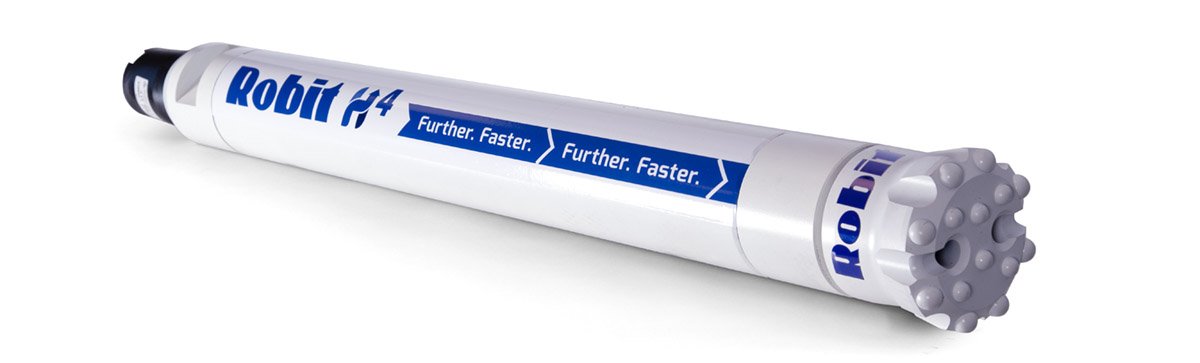
For about a year, Robit has been developing a new four-inch DTH hammer, branded Robit H4, for well drilling. Testing in cooperation with customers is an integral part of product development. The H4 hammer was optimized and finalized as per customer feedback. Robit’s Sales Director Kimmo Kangas approached Oulun Porakaivot and offered them an opportunity to test the new hammer. A suitable test site was found in Helsinki, at a housing cooperative’s future energy field, where 23 wells will be drilled to a depth of 390 metres. Kimmo has followed the development of the H4 hammer from the beginning and has seen its potential.

“The functionality, reliability and penetration rate of the H4 are outstanding. However, the most significant improvement is fuel consumption, which is significantly lower than the competition. Typically, for example, in a 200-meter well, the compressor consumes about two litres of fuel per meter. On the H4 hammer, the consumption has been as low as one and a half litres. That’s a crucial difference,” says Kimmo.

Low fuel consumption is one of the key assets of the H4 hammer.

Panu Haulos confirms that the H4 has achieved very low fuel consumption figures at the drilling test site. The two companies have been in close cooperation for years.

“Robit’s domestic production is definitely a plus for us: we can get parts with a fast response time. They react quickly to our needs, around the clock if necessary. Robit has also been able to help in special cases where off-the-shelf products have not been available. For example, we had a project where the hole we were to drill had to be absolutely straight. Robit tailor-made us a special guiding rod that did the job,” says Panu.

In many sectors of the economy, growth indicators have recently taken a downward turn. This is not the case in the thermal well market, at least not for Oulun Porakaivot.

“The trend is upward, and demand is constantly growing and diversifying. Of course, this is partly due to technological advances that allow us to drill deeper wells. In Finland, the city of Helsinki, in particular, is a strong driver of progress in this field. The city, striving to move away from fossil-based district heating, has streamlined the permitting process for geothermal heat”, Panu says.

Picture from left: Ville Alanko, Simo Manninen, CEO Sami Manninen, Panu Haulos (Oulun Porakaivot); on the right Kimmo Kangas (Robit).

OCI: A POWERFUL PARTNER IN THE US MARKET

OCI, LLC, headquartered in Brookville, Pennsylvania, has been servicing the US drilling industry since 1997. Their core businesses include designing and building drilling tools and systems, equipment sales, rental and service, and consulting clients on methods and materials in their drilling projects.

OCI’s sales offering includes Down the Hole hammers and shock absorbers. UK-based Bulroc rose to prominence in the 1970s as a leading manufacturer of DTH hammers and related accessories. Jim Rupert, one of the founders of OCI, had been working with Bulroc hammers since the early 1980s, and it was only natural that when OCI was founded in the 1990s, they would partner with Bulroc.

The same successful partnership continues to this day with OCI and Robit, which acquired Bulroc in 2016. DTH hammers, along with piling tools, remain a key part of the Robit product line in OCI’s varied portfolio.

“We are a design and build manufacturing company that also mass produces micro piling casing and other industry products. We manufacture the micropile casing and the tooling used along with it. Our offerings include sub adapters, head adapters, swivels of various models, drill pipes of various types, drill string components, augers, core barrels, kelly equipment, and auxiliary equipment. We are not limited to a product line; we offer unique opportunities to manufacture specialized drilling and construction equipment “, says Dave Franklin, Technical Sales and Project Management at OCI.

The OCI–Robit partnership continues to serve the drilling industry across North America successfully.

“OCI feels we have a strong, healthy relationship with Robit, and we look forward to many opportunities in the near and distant future. Our clients have always been happy with Robit tools and the support we offer them as a team approach. Together, we provide a full scope of products and services,” Dave Franklin sums up.

Picture: The OCI headquarters in Brookville, PA.

DWARSRIVIER CHROMIUM MINE IMPROVING PRODUCTIVITY WITH ROBIT’S TOOLS

BIC is an acronym most geologists are familiar with. It stands for Bushveld Igneous Complex, situated in South Africa. It’s one of the world’s most significant geological features due to its size, age – and mineral wealth.

BIC is the largest layered igneous intrusion within the Earth’s crust. Put simply, a layered intrusion is an underground formation of rock formed from magma that cooled down and solidified in layers, much like a layered cake. Each layer can have different types and concentrations of minerals, making these formations especially interesting for geologists and mining companies.

The Bushveld Complex contains the world’s largest known resources of platinum group metals, chromium, and vanadium. Most of the chromium resources are concentrated on the eastern limb of the Complex, which runs across Limpopo, the northernmost province of South Africa. One of the major producers of chromium ore in Limpopo is the Dwarsrivier mine, located some 130 km southeast of Polokwane, the provincial capital.

The Dwarsrivier mine has been in operation since 1999. Since 2015, it has been run by Assore South Africa. The mine produces more than a million tonnes of chromium ore yearly.

Mining is a competitive industry, and cost control plays an important part – and this applies to drilling tools as well. Recently, the Dwarsrivier mine began to use Robit’s Top Hammer drilling consumables.

“Drilling requirements are essential to ensure that face holes for blasting are drilled fast, efficiently, and within budget. Quality and cost are the top priorities”, says Dewet Pretorius, Mining Manager at Dwarsrivier.

In addition to cost and quality, Dwarsrivier were on the lookout for a supplier with effective after-sales service – something that had been lacking up until then.

“With Robit, our overall costs have decreased, production has improved, and the Robit team is providing us with good after-sales service as well”, Mr Pretorius says.

South Africa holds about 70% of the world’s chrome reserves and is the largest producer of ferrochrome in the world. Dwarsrivier will continue to contribute to this effort for a long time: the current plan extends the mine life well into the 2040s.

In the picture from left: Babra Shai, Site supervisor, Robit – Dewet Pretorius, Mine Manager, Dwarsrivier – Trevor Van Biljon, Area Sales Manager, Robit

WESTAUZ CHOSE ROBIT FOR THE NORSEMAN GOLD PROJECT

In the late 19th century, gold fever was running high in certain southern parts of Western Australia. Among the prospectors were two brothers from the Shetland Isles, Lawrence and George Sinclair. They finally struck gold some 20 km north of Dundas, an already established find, and quickly realized the gold deposit was very prosperous. The Sinclair brothers founded a town on the site and named it Norseman – after their horse.

Today, that corner of Western Australia is known as the Goldfields region. The Central Norseman Gold Mine was founded there in 1935 and ran until 2014, making it Australia’s longest continuously-running gold mining operation. During that time, it produced over 5.5 million ounces, or more than 150 tonnes, of gold.

The gold reserves in the area were far from depleted, though. A few years later, Australian gold producer Pantoro Limited acquired 50% ownership of the Norseman Gold Project and, in 2022, brought back online three mines: the OK underground mine, the Scotia open pit and the Green Lantern open pit.

Underground operation at the Norseman OK mine is contracted by Westauz Mining, headquartered in Kalgoorlie, Western Australia. At the proposal of Robit’s Sales Manager Steve Tedge, Westauz agreed to run a development bit trial at Norseman OK in December 2022. Since Robit’s bits outperformed the competition by far in terms of cost-per-meter, Westauz awarded the drilling consumables business to Robit in early 2023.

“Throughout 2023, volumes have only grown at the OK mine site as the decline has been rehabilitated and access gained to the gold ore. Westauz is now using our Top Hammer underground bits, rods, shanks, and couplings”, says Steve Landreth, Robit’s Vice President Australasia.

Westauz have expressed their satisfaction with Robit’s can-do attitude and willingness to work with their customer. “In the early stages of the agreement, Westauz requested Robit make a design change to the development bits. Our engineering team was happy to oblige, and the bit now provides productivity gains in the drilling process. We are receiving very positive feedback, ranging from the Managing Director, General Manager, Project Manager, Mine foreman and operators”, Steve Landreth says.

For Westauz, the Norseman project has marked a significant growth in business. Plenty of excavating remains to be done at the site for years to come: according to current estimates, the remaining mineral resource in the area is around 4.8 million ounces, or some 136 tonnes, of gold.

Picture: Westauz jumbo at work & Norseman the horse has a statue in the town that was named after him.

FINGEO RELIES ON DOMESTIC WEAR PARTS IN DRILLING AND PILING

Fingeo is a Finnish drilling and piling contractor with solid experience. They also carry out more extensive projects, including civil engineering. For drilling consumables, the company relies on the quality, reliability, and competitive price of domestic Robit.

Founded in 2008, Fingeo Oy is now part of the E.M. Pekkinen Oy group.

“Our goal has been to develop our operating methods and provide a high-quality overall service. Fingeo has traditionally been strong in drilling and piling contracting. In recent years, we have expanded our service offering to include extraction by wedging and blasting and rock reinforcement by shotcrete, grouting and bolting. “We now also offer comprehensive foundation work contracts, which makes it easier for the client as the same contractor takes responsibility for the work from start to finish. We have the flexibility to handle smaller projects as well as larger ones. Our extensive experience in soil and rock drilling, together with other civil engineering professionals, ensures an overall sustainable contract and smooth project management,” says Veli-Antti Pekkinen, Project Manager at Fingeo Oy.

Construction continues to be strong in the Helsinki region

While Fingeo’s operations mainly focus on the Helsinki metropolitan area, several projects, particularly demanding piling contracts for industrial and bridge projects, are carried out throughout the country.

“In the future, we will increasingly offer our services in different parts of the country, especially in challenging projects and large turnkey contracts. We have plenty of work for the rest of the year as construction in the capital region continues to be strong on the ongoing sites. As for new projects, the future is not quite as clear,” says supervisor Jukka Jääskeläinen.

Wide variety of work methods, skilled staff

For drilling and anchoring, Fingeo uses a large variety of methods and a wide range of special equipment.

“Our pipe piling projects range from a few piles to construction sites with several thousand piles. Tensile anchoring is used, for example, in trench shoring to absorb tensile forces. Our areas of expertise also include specialities like offshore drilling from a raft and combi walls for trench support.”

“The backbone of our equipment consists of pipe piling and anchoring machines and drill rigs, of which we have about a dozen units. While the machinery is state-of-the-art, our motivated and highly skilled staff is key to successful projects. Our team has an excellent working atmosphere. Our minimal turnover rate speaks for that,” says Kai Jaakkola, supervisor.

Robit – the trusted partner for consumables

Drilling and piling is a consumable-intensive business. Fingeo’s main supplier in these applications is Robit, with its products manufactured domestically in Lempäälä.

“At the moment, we get practically all our wear parts from Robit: for quarrying, that includes rods and bits; for piling, we use their reamers, pilot bits, and DTH hammers. We appreciate their domestic manufacture and great customer service that ranges from sales to delivery to problem-solving. Robit actively develops technically advanced products, and the manufacturing quality is high. Their consumables allow us to drill further, resulting in cost savings. And while Robit’s products are definitely at the top of the market, they are also competitively priced. It’s quite a rare equation,” Jääskeläinen and Jaakkola say.

CERRO CORONA: TESTING IN THE SHADOW OF A PANDEMIC

Thanks to its rich gold deposits, the Cajamarca region in northern Perú has been home to gold mines since the Inca times. One of the current mines is Cerro Corona, where Robit recently became the preferred supplier of DTH drill bits.

Cerro Corona mine, owned by Gold Fields Inc, is located on the eastern slope of the western Andes, some 80 km north of the regional capital of Cajamarca. The open pit mine is expected to produce some 2.1 Moz (about 60,000 kg) of gold and 407 kt of copper in concentrate over its 15-year mine life.

The rich gold deposit is hosted by diorite porphyry, an extremely hard rock embedded in limestone. MUR-WY, the drilling contractor at Cerro Corona, uses the so-called pre-splitting method, where closely spaced holes are drilled and lightly charged, causing fractures that isolate the gold-bearing rock from the surrounding rock mass. Successful pre-splitting requires very straight holes, and, as always, this should be achieved with optimal cost, penetration rate, and tool lifetime performance.

Robit believed their tools might improve productivity, so they contacted MUR-WY in 2021 to arrange test drillings for 5” DTH bits at Cerro Corona. Test drilling is typically a very hands-on type of work where you monitor and make adjustments on the spot with the contractor. However, the COVID pandemic complicated things.

“In 2021, access to the mine was heavily restricted, so we had to get creative with MUR-WY to follow up on the tests. We ended up monitoring the performance remotely through WhatsApp videos and messages”, says José Luis Cisneros, General Manager of Robit SAC.

Luckily the restrictions were eventually lifted, and Robit’s Regional Sales Manager, Martín Rodriguez, was able to revisit Cerro Corona and conclude the tests, which proved highly successful.

“On average, compared to the tools they had used, we reached 20 to 25% better yields with our DHD340 Flat Face Premium bits and 40 to 50% better with our D45 HD hammers.

“We detected several ways to improve productivity. Not only did Robit’s components perform better, but a key factor is also the service we can provide. We are now the preferred supplier for DTH consumables at Cerro Corona. There are still challenges to tackle, but we will work with our strategic partners from MRU-WY to articulate better ways to approach their needs and increase security regarding the project’s required logistics”, Martín says.

BUILDING A NEW NEIGHBORHOOD IN STOCKHOLM

In the first half of the 20th century, the Norra Djurgårdsstaden district in Stockholm, Sweden, was a busy industrial center and port area with an oil port, a coal port, a free port, and even a seaplane base. Today, it is one of the largest urban development areas in Europe.

The Norra Djurgårdsstaden development project was kicked off in the early 2010s. The first 700 apartments were completed in 2012, and construction work is expected to continue well into the 2030s.

The overall plan includes construction work in five sub-areas in the district. One of them is Project Saltkajen in Södra Värtahamnen, where a new pier with an associated bridge will be constructed, and the existing quay will be rebuilt. The city of Stockholm signed the contract, worth SEK 610 million, with Skanska.

Foundation work for the project includes extensive pipe piling and sheet piling in demanding conditions: more than 500 SSAB RD pipe piles (711 mm and 508 mm) will be drilled and connected by welded interlocking sections, creating a continuous retaining wall against horizontal and vertical loads.

Skanska chose the Robit Steel Fist (SF) casing system to drill the RD piles. SF is a solid choice for all DTH applications where the casing is left in the ground. Skanska has successfully used it in previous projects, such as the Slussen reconstruction in Stockholm.

As construction continues, Norra Djurgårdsstaden is slowly transforming into a modern, environmentally friendly, sustainably built district with 12,000 homes and an estimated 35,000 new jobs. Värtahamnen will be home to some 5,000 people, and 20,000 will work there. With new walkways, shops, restaurants and nightlife, it will also be an inviting entry point for international visitors arriving in Stockholm by boat.