Robit® H Series DTH Hammers – Proven Performance Around the World
From deep geothermal wells in Finland and water well drilling in Australia to demanding open-pit mines in South Africa, Peru and the Arctic conditions of Finnish Lapland, Robit® H Series DTH hammers are proving their performance in real-world drilling operations around the globe.
Developed to combine high performance, lower energy consumption and flexibility, the Robit® H Series represents a new generation of Down-the-Hole hammers. Today, customer experience from very different drilling environments is demonstrating what the H Series was designed to deliver: more efficient drilling, reliable performance and lower total drilling cost.
One platform. Different conditions.
No two drilling operations are the same. Ground conditions, applications, compressor capacity and performance requirements can vary considerably from one site to another.
That challenge was one of the starting points for the H Series.
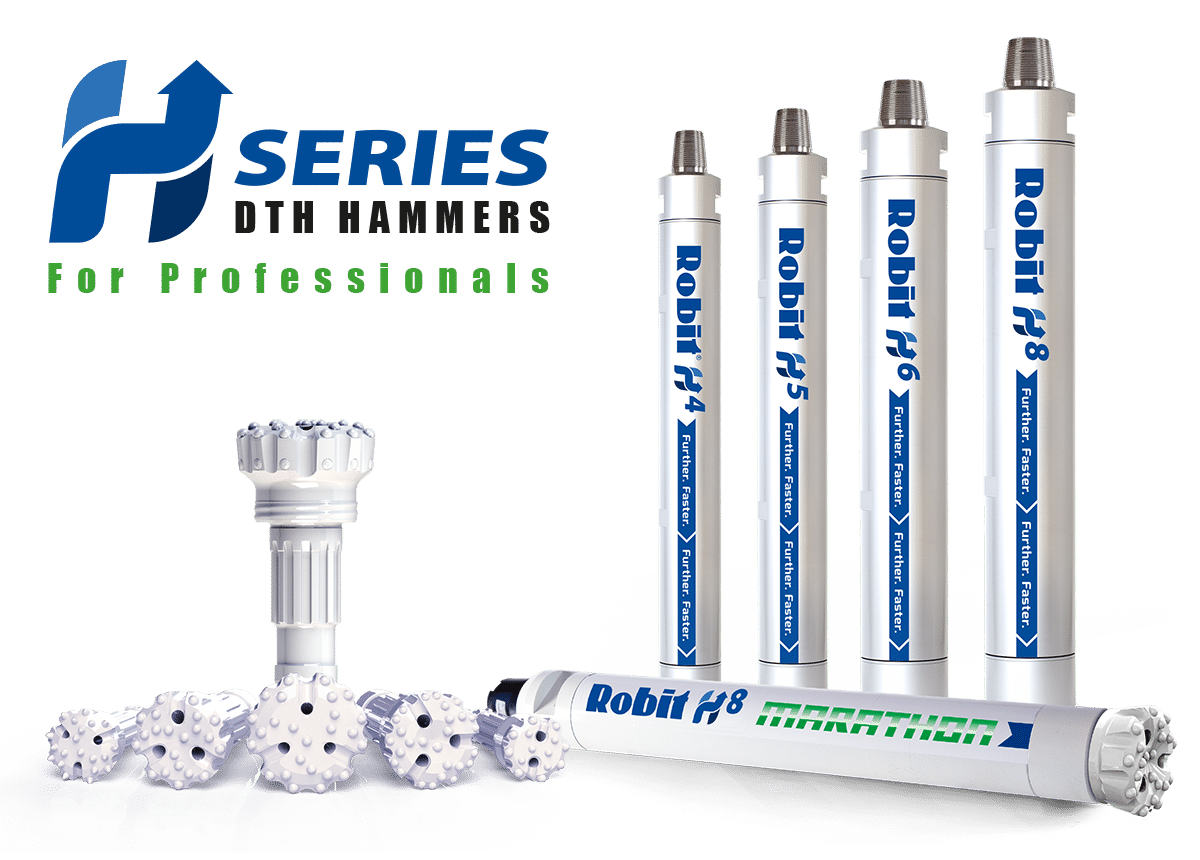
Available in 4, 5, 6 and 8-inch sizes, the H Series features a modular architecture that enables up to twelve configurations from a single base assembly for each hammer size. Two inner cylinder displacements allow the hammer to be optimized either for maximum power or for efficiency with reduced airflow demand. By changing only two parts, the hammer can also be converted between footvalved and tubeless configurations.
But specifications only tell part of the story. The real measure of a drilling tool is what happens when it meets the rock.
Finland – lower fuel consumption in deep well drilling
Finnish geothermal specialist Oulun Porakaivot tested the H4 in deep geothermal wells. Reliability is particularly important in this application, where wells can reach depths of up to 450 metres.
During H4 testing, fuel consumption was identified as one of the most significant improvements. According to Robit Sales Director Kimmo Kangas, where a compressor would typically consume around two litres of fuel per drilled metre in a 200-metre well, consumption with the H4 was measured as low as 1.5 litres per metre.
The result highlights an important principle behind the H Series: drilling performance should not be considered separately from energy consumption and overall cost per metre.
Australia – more metres per day
Thousands of kilometres away in Far North Queensland, Australia, FNQ Drilling put the 6-inch H Series hammer through its paces in water well drilling.
Conditions in the region vary significantly, from shale, basalt and granite to marble, clay and schist – making versatility and reliability essential. After approximately 500 metres of validation drilling, owner Shane Naude reported better wear across the hammer components compared with competitor products he had previously used.
“I’m achieving more drilled metres per day. The penetration of the hammer is powerful and punchy, which decreases the time needed to drill a hole. I have also noticed a reduction in my fuel consumption,” says Shane.
South Africa – lower cost per drilled metre
The H Series has also demonstrated its capabilities in demanding African mining conditions.
At the Phalaborwa open-pit phosphate mine in South Africa, Brauteseth Blasting tested the 6-inch H Series hammer. According to Plant Manager Owen Du Plooy, increased penetration contributed to a 5% reduction in cost per drilled metre. The company also highlighted easy maintenance, wear sleeve life and Robit’s technical support.
At the Lwala open-pit chrome mine, Zizwe Opencast Mining tested the same hammer in challenging conditions including fractured rock, sandstone and clay. Operational Manager Derik Van Deventer reported improved penetration rates and faster hammer maintenance.
Peru – longer life in extremely abrasive rock
Some drilling conditions put wear resistance above almost everything else.
At the La Arena copper-gold mine in Peru, Acciona tested the H4 Marathon hammer in extremely abrasive volcanic and intrusive rock during pre-splitting operations.
The comparative trial produced a clear difference: the Robit H4 Marathon achieved 4,740 drilled metres, compared with 3,100 metres for the competing hammer. The H4 Marathon also delivered penetration rates approximately 30% faster than the competing product.
The results demonstrate the purpose of the H Marathon Series, which builds on the H Series platform with additional protection for wear-critical components such as the drive chuck and wear sleeve.
Arctic Finland – tested from –40°C to +35°C
At Boliden Kevitsa in Finnish Lapland, the H8 has faced another type of challenge: extremely tough and abrasive rock combined with major seasonal temperature variations.
According to Drilling Development Coordinator Juha Ranta, drilling equipment at Kevitsa must perform reliably in temperatures ranging from around –40°C in winter to +35°C in summer. Operator feedback on the H8 has highlighted good penetration, ease of drilling and promising durability.
Kevitsa is also using the H8 Marathon, featuring a wear-protected outer casing. Development work with Boliden has focused on extending hammer life and reducing downtime and spare-part consumption – ultimately improving cost per drilled metre.
Performance that translates into lower drilling cost
Different continents. Different applications. Different rock conditions.
The common objective is the same: drill more efficiently and reduce the total cost per drilled metre.
Field experience with the H Series demonstrates the benefits across water well drilling, geothermal drilling, quarrying and demanding mining applications. Depending on the application and configuration, customers have reported improvements in penetration rate, fuel efficiency, wear life, maintenance and overall drilling economics.
The H Series combines:
- Up to 25% lower fuel consumption
- High penetration performance
- Modular configurations for different drilling conditions
- Footvalved and tubeless options
- Maximum Performance and High Efficiency configurations
- H Marathon options for increased wear resistance in abrasive conditions
From Finland to Australia, South Africa and Peru, the H Series is no longer just a new hammer concept. It is a field-proven platform built to deliver where it matters most – at the bottom of the hole.
High performance. Lower air consumption. Reliability you can count on.
Discover the Robit H Series
Explore the H4, H5, H6 and H8 DTH hammers and find the configuration for your drilling application.
Released models – download the brochure:
- Robit® DTH Hammer H4 API 2⅜IN Reg Pin
- Robit® DTH Hammer H5 API 3½IN Reg Pin
- Robit® DTH Hammer H6 API 3 ½IN Reg Pin
- Robit® DTH Hammer H8 API 4 ½IN Reg Pin
Maintenance manuals: Manuals
Watch the H Series assembly video: Robit® H Series assembly video
Download references: Robit® H Series references